Access to remedy
Specific Articles
Bonded Labor
Overview Articles
Specific Articles
Business and Human Rights
Overview Articles
Takeshi Shimotaya
Specific Articles
End of Mission Statement
Social Media Exchange
Voltaire J. Veneracion and Agni Mentaki Tripodi
Korean Transnational Corporation Watch
Huang Zhong and Qian Cheng
Caste Discrimination
Overview Articles
Specific Articles
Domestic Violence
Overview Articles
Editorial
Violence against women is a scourge of society. Laws tolerate violence against women by failing to consider it a crime or by punishing it lightly. Society tolerates this violence by being silent about it.
Women and their organizations demand that any form of violence against women (or any member of the family) be ended in practice and in law. They question the social and cultural bases of violence against women. They urge the public to discuss the effects of such violence on women and members of the family. They seek the understanding of people on the need to take action, or to improve measures, against it. They lobby for law reform--to enact new laws, or revise or repeal old laws--in order to appropriately penalize such violence.
Decades earlier, the United Nations called on countries to make violence against women a criminal offense and to take active steps to prevent its occurrence. At present, there is still much work to do to eliminate violence against women.
Violence against women, as a grave human rights violation, has to be addressed at various levels. There must be initiatives directed at the national government as much as the local government. There must likewise be efforts at dialoguing with people in the community regarding socio-cultural norms and practices, and other causes of this violence.
While women and their organizations have taken the lead in eliminating this violence, the pursuit of this difficult task needs the involvement of the society as a whole.
Specific Articles
KAFA
Lebanon is not known for exacting efforts in securing the human rights of the people. With all the problems that the country has gone and is still going through, a focus on human rights (more specifically, women's rights) becomes more of an after-thought rather than a priority.
Violence Against Women
Gender-based violence, domestic violence specifically, is a big problem in Lebanon much like anywhere else. Statistics concerning this problem speak for themselves; however, it is important to remember that as much as we would like to get accurate data and analyses, we must recognize the stigma surrounding this taboo topic. This stigma causes many women to choose not to come forward out of fear of repercussions of various types (sexual, verbal, physical or psychological assaults and withdrawal of financial support). Complaining against domestic violence means more suffering from violence by the women. Even though some of these acts are penalized under Law 293 (the Lebanese law on domestic violence), men have escaped prosecution under this law. This makes the law complicit to the acts of domestic violence in some cases.
In 2019, the support center of KAFA received 1,107 new cases with 26 percent of the women experiencing various types of physical abuse including choking (3 percent), beating (9 percent), scarring (8 percent) and attempted murder (2 percent). KAFA helped the Internal Security Force (ISF) of the country establish a telephone hotline for these women (1745), which now has personnel assigned to answer the phone calls. KAFA has its own telephone hotline (03018019) since its establishment in 2005.
Legal Issues
Laws concerning women's issues in Lebanon--including domestic violence, prostitution and exploitation, child custody, among others--can best be described as outdated and backward. This led many organizations across Lebanon including KAFA (Enough) Violence and Exploitation to start lobbying many years ago for the amendment of such laws, as well as propose new ones, to ensure the safety of women and girls across the country.

A big demonstration held on 8 March 2014 in Beirut on the draft law to protect women from domestic violence before its enactment on 1 April 2014.
To add insult to injury, since Lebanon's personal status laws are based on Christian and Muslim ideals that should govern family-related issues, amending them has become implausible due to the sectarian system that plagues the country. Lebanese laws are like an onion: the more you peel it, the more layers appear, and some layers are close to impossible to remove. This is why the NGOs have to do the work required to serve and protect the women in the country regardless of their race, social status, age or nationality.
Before the domestic violence law (Law 293) existed, the absence of an adequate law on domestic violence was a threatening barrier to women's rights in Lebanon. Pending since 2010, the Lebanese Parliament finally passed the domestic violence law on 1 April 2014. However, KAFA is working to amend Law 293 to rid it of loopholes.

Placard saying "Killing women because they are women continues. Amend Law 293." Demonstration in Beirut, early 2019.
Every year, women's rights gain little successes. For example, in 2017, Article 522 of the Penal Law was repealed after a lengthy campaign and public awareness-raising by NGOs. Article 522 of the 1940s-vintage Penal Law provides that rape is punishable by up to seven years in prison with a higher penalty for raping a minor. However, the article also states that a man who raped an unmarried woman can avoid prosecution for the crime by marrying the victim. Article 522 provides:
In the event a legal marriage is concluded between the person who committed [crimes including rape, kidnapping and statutory rape], and the victim, prosecution shall be stopped and in case a judgment [of conviction has been] rendered, the execution of such judgment shall be suspended against the person who was subject to it.
While Article 522 was repealed, its provision was retained in two articles, Articles 505 and 518, of the Penal Law. KAFA issued a statement on this issue:1
Article 505 refers to mating with a minor as a crime punishable by the law, and mentions this crime under the "rape crimes" sub-chapter. However, the amendment of the Article as approved by the members of the Administration and Justice Commission and adopted by Parliament, places the offender again in front of two choices: Imprisonment or marrying the victim if she is aged between 15 and 18 ...
Laws and legal provisions such as these exist in the Lebanese legal system, and the general public may or may not be aware of them (as in the case of public ignorance of Article 522). A notable example is the child marriage law. To this day, NGOs have been advocating the raising of minimum age of marriage to eighteen years. Unfortunately, marriage is under the personal status legal system, where the applicable personal law depends on the religion and sect of the people involved. Each religious or ethnic community has its own personal law. KAFA continued its lobbying and advocacy campaigning on this issue in 2019. It is advocating the passage of a unified personal status law. This proposed law would ensure equality among family members regarding marriage, divorce, child custody, finances and security regardless of their religion or sect.
Campaign
It is important to acknowledge that online campaigning has played a huge part in advocating for all aspects of women's rights in Lebanon. Whether it be the anti-child marriage campaign or the "Abolish 522" campaign, their presence in the internet has played a monumental part at gathering and assembling masses of people, educating people online, and spreading awareness about various other issues. This is why the status of women's rights in Lebanon has changed the most this past decade more than before. It is also important to include the women's marches that have been happening yearly on Women's Day. Many organizations have been successfully calling on people to participate, normalizing activism and spreading the good word. This sort of pressure on politicians is what is needed, especially more recently during the October Revolution in 2019, when another march took place rallying people against rape, other sexual assaults and sexual harassment which are still not taken seriously by the law. This was exacerbated by an event that happened at the time when a serial rapist, with many testimonies and evidence from many victims against him, was still allowed to roam free without punishment. This is not a single instance in Lebanon but a frequent occurrence that has been brushed off for too long and the people and organizations will not rest until the goal of protecting women is achieved.
The COVID-19 lockdown made things harder for women victims of domestic abuse. Being stuck at home 24/7 with their abusive relatives (whether husband, father, etc.), women have been experiencing more and more violence from these individuals. This, in addition to the various economic and security issues in Lebanon, the lockdown put the women in more harm's way with the temper of these men having risen for the worse. KAFA observed a rise in domestic abuse reported through calls to its helpline over the last few months, with the number of calls rising to 1,371 calls in June 2020. However this is a conservative estimate since the lockdown led these women to be watched by the men the whole time, making it increasingly harder to report abuses, whether by Lebanese or Syrian refugee women stuck in their camps. Additionally, the ISF has reported that its telephone hotline (1745) dedicated to domestic violence complaints has registered a rise of 100 percent in incoming calls, in comparison with the number of complaint calls in March 2019.
Unfortunately, cases of extreme violence also happened, with a father killing his wife and young daughter. But on a more positive note, eleven of the sixteen requests for protection submitted by KAFA to the Public Prosecution have been granted during the month of June 2020.
Concluding Statements
KAFA condemns the Lebanese government for not protecting the women and not enforcing laws that would ensure their protection. Mere government planning and strategizing do not amount to anything on the ground. The government has to take concrete actions as soon as possible because this gap has a body count; too many women are suffering because of a system built against them. The ministries and other governmental agencies need to step in and help these women by providing refuge/shelter or legal assistance, and by stopping the practice of putting this responsibility on the NGOs. Lebanon is notorious for relying on these NGOs for all these social issues. The Ministry of Social Affairs needs to get its priorities in order and do its job.
As reported by UN Women, Lebanon ranks low in the equality index:2
Lebanon is currently placed 145 out of 153 countries on the World Economic Forum Global Gender Gap Index 2020.3 In terms of prevalence of domestic violence, 65 per cent of reported incidents are committed by family members, and 71 per cent took place inside the survivor or perpetrator's household. Moreover, 18 per cent of reported cases of Violence Against Women (VAW) involve incidents of sexual violence, of which 8 per cent involve rape (2016).
Lebanon still has a long way to go to achieve equality between women and men as long as the government is not completely repealing outdated laws and providing actual assistance to women in need.
KAFA (Enough) Violence & Exploitation is a feminist, secular, Lebanese, non-profit, non-governmental civil society organization based in Beirut.
For further information, please contact: KAFA (Enough) Violence & Exploitation, 43, Badaro Street, Beydoun Bldg., First Floor, Beirut, Lebanon, ph 961-1-392220; fax 961-1-392220; e-mail: kafa@kafa.org.lb; www.kafa.org.lb.
Endnotes
1 "Article 522 is not fully abolished," KAFA, 17 August 2017, www.kafa.org.lb/en/node/124.
2 Lebanon, UNWomen Arab States, https://arabstates.unwomen.org/en/countries/lebanon.
3 See Table 1, The Global Gender Gap Index 2020 rankings, Global Gender Gap Report, World Economic Forum, page 9, www3.weforum.org/docs/WEF_GGGR_2020.pdf.
Aizada Arystanbek
As an introduction to my essay, I would like to emphasize that Kazakhstan may have all the symptoms of the "shadow pandemic"1 of hate or distrust for women (misogyny) similar to other Central Asian and other post-Soviet "-Stans" (Kyrgyzstan, Tajikistan, Turkmenistan and Uzbekistan). However, it would be remiss to treat its case as a blueprint for every Central Asian country. As someone who was born and raised in Kazakhstan, I understand my privilege of being from, what is often described, one of the most stable and prosperous authoritarian countries in the subregion. I would also like to highlight that, as tempting as it may seem, judging a whole subregion based on one country would always be fallacious. Thus, I offer my essay to anyone who wishes to learn more about what is happening to women in Kazakhstan. I also would like anyone who reads it and is not from Central Asia to keep in mind that contexts shift and to treat it as one of many narratives of Central Asian women who deserve to be heard and understood.
Violence against Kazakhstani Women
Violence against women (VAW) is globally recognized as a violation of fundamental human rights. Progress towards dismantling patriarchy and achieving gender equality is not a step-by-step fight where first comes eradication of violence followed by some "minor" problems such as equal pay and representation. Gender equality can only be achieved by fighting for all women's rights at the same time. However, gender-based violence continues to be a particularly cruel and pervasive issue that plagues every society today.
Some even say that it seems to be getting worse and hopeless given the number of stories that are being shared through social media today about women falling victims to domestic abuse, rape, and murder. However, as I would argue, what we are seeing in Kazakhstan today is not necessarily an indicator of hopelessness. On the opposite, it could be that for the first time in decades, there is more hope than there ever was before.
In my research on the ways through which the nationalist rhetoric in Kazakhstan normalizes gender-based violence with "re-traditionalization,"2 a discourse analysis of the social media content on Instagram and Facebook demonstrated a dangerous pervasiveness of victim-blaming and equating misogynistic practices with core Kazakh cultural values. Kazakhstan, similar to many other countries in the world right now, has not been immune from the rise of right-wing nationalism that utilizes women's bodies as markers of cultural and ethnic borders. Kazakhstani women who share their stories of abuse and trauma are continuously gaslighted and their innocence is questioned in the public discourse, while proper legal punishment is rarely meted out.
One of the most controversial recent cases is the 2018 Talgo case about the rape of a woman by two train conductors in her own train compartment during a night trip.3 The details of what happened that night and the woman's behavior including drinking habits, age, and intellectual abilities have become a topic of avid discussion. The victim has been blamed for such irrelevant things as not closing the door of her compartment and talking to the conductors hours prior to the attack. This case serves as a good example of how gender-based violence is perpetuated among people by discussing this violence in connection with everyday conversations on the roles of women in society. The Kazakhstani government view on this issue seems to myopically focus on women as mothers, wives, and daughters rather than fully equal members of the society, which is what the Constitution of the country provides at least on paper. For instance, the high divorce rate continues to be discussed as a gender equality issue that needs to be overcome with multimillion budgets and resources propagating "traditional ethnocultural values," which imply heteronormative4 gender roles of a man being the breadwinner and the leader of the family and a woman being a malleable figure whose main purpose is to raise children. There is no critical discussion of the reasons why so many women choose to leave their marriage and the relation of the divorce rate to a high rate of domestic abuse in the country.
According to UN Women, about four hundred women in Kazakhstan are killed annually as a result of domestic abuse.5 In 2017, Nursultan Nazarbayev, then President of the country and holder of the title "Leader of the Nation," decriminalized domestic violence and made it a mere administrative offense, which effectively contributed to the casualization of domestic abuse.6
Policy against VAW
2019 was a tumultuous year for Kazakhstan with the transition of power from Nazarbayev to Qasym-Zhomart Toqayev and a growing unrest among the public spilling into peaceful protests and a surge of political and civil activism.7
VAW seems to have become one of the front issues in the turning point of independent Kazakhstan's history. For the first time in years, President Toqayev addressed rape as an important problem and called for more stringent and thorough punishment for it. However, the progress so far seems to be artificial in nature. Not long after his condemnation of rape of women (which also instilled heteronormativity8 on the issue), President Toqayev signed a new law with a provision that changed the previous penalty of fine to a simple warning for first-time domestic violence abusers. With such continuous decriminalization of gender-based violence, the Kazakhstani government appears to be going backward by reforming existing laws to offer even less protection for women.
However, I believe that the most important thing to understand here is that the actual situation of women in Kazakhstan lies beneath the laws and policies. These laws and policies can only account for so much that is happening in a country with rampant corruption and constant crackdowns on civil liberties. On paper, Kazakhstan has ratified the Convention on the Elimination of All Forms of Discrimination Against Women (CEDAW) and has continuously pledged allegiance to the goal of achieving gender equality in the country.9 This has helped Nursultan Nazarbayev and his authoritarian regime to window dress the country as an appropriate ally and partner of liberal democracies of the West.
While the legal protection of victims of gender-based violence grows weaker, a more important issue is the underreporting and misunderstanding of such violence. It has become normal in the daily life of Kazakhstani people to hear misogynistic jokes and "vines"10 that depict survivors of gender-based violence as hysterical, conniving or both.
Movement for Change
A crucial element that lies beneath the surface is a rapidly growing feminist movement in the country. It is important to note here that while social media has been disseminating in recent years ideas and information on gender equality from various sources, Kazakhstani feminist activists have been working for decades away from the limelight. They have been helping other women and advocating for gender equality by establishing non-profit advocacy organizations, opening makeshift shelters and crisis centers, etc. Recently, social media has been providing an unprecedented level of exposure to feminist organizations and activists in Kazakhstan that keeps the public conversation about violence against women going. From art projects to petitions and marches, women in Kazakhstan are taking more virtual and physical public spaces than ever before. This novel exposure of the extent of suffering from VAW in Kazakhstan may be disheartening to many and give a feeling of hopelessness. However, in the past year, I have personally noticed more and more people actively engaging with questions of feminism, gender equality, and violence against women in different forms and degrees of involvement. Education about these issues takes place in real-life meet-ups, press conferences, social media posts, online lectures and panels, and articles in online magazines. It is still sad to see that the burden of raising awareness about violence against women lays on the shoulders of women themselves. But the women in Kazakhstan have been turning this burden into a momentum of change.
The first International Women's Day feminist march was held in Almaty on 8 March 2020 with more than two hundred participants.11 Before that, on 28 September 2019, a peaceful feminist protest against gender-based violence was organized in the same city for the first time in the history of independent Kazakhstan.12
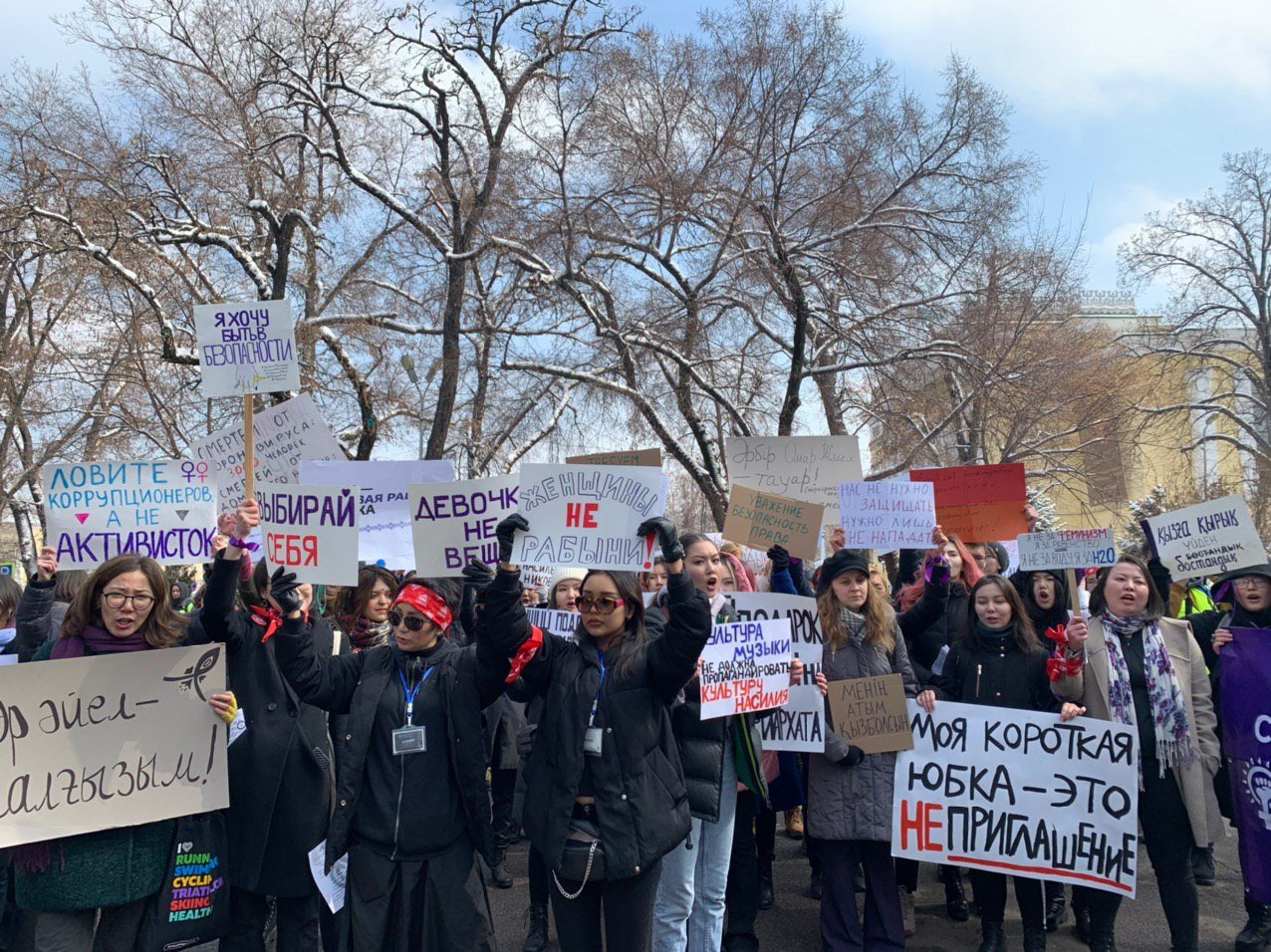
Kazakhstani women marching against VAW and sexism on 8 March 2020 in Almaty Kazakhstan. (Photo: Yuna Korostelyova, Vlast.kz)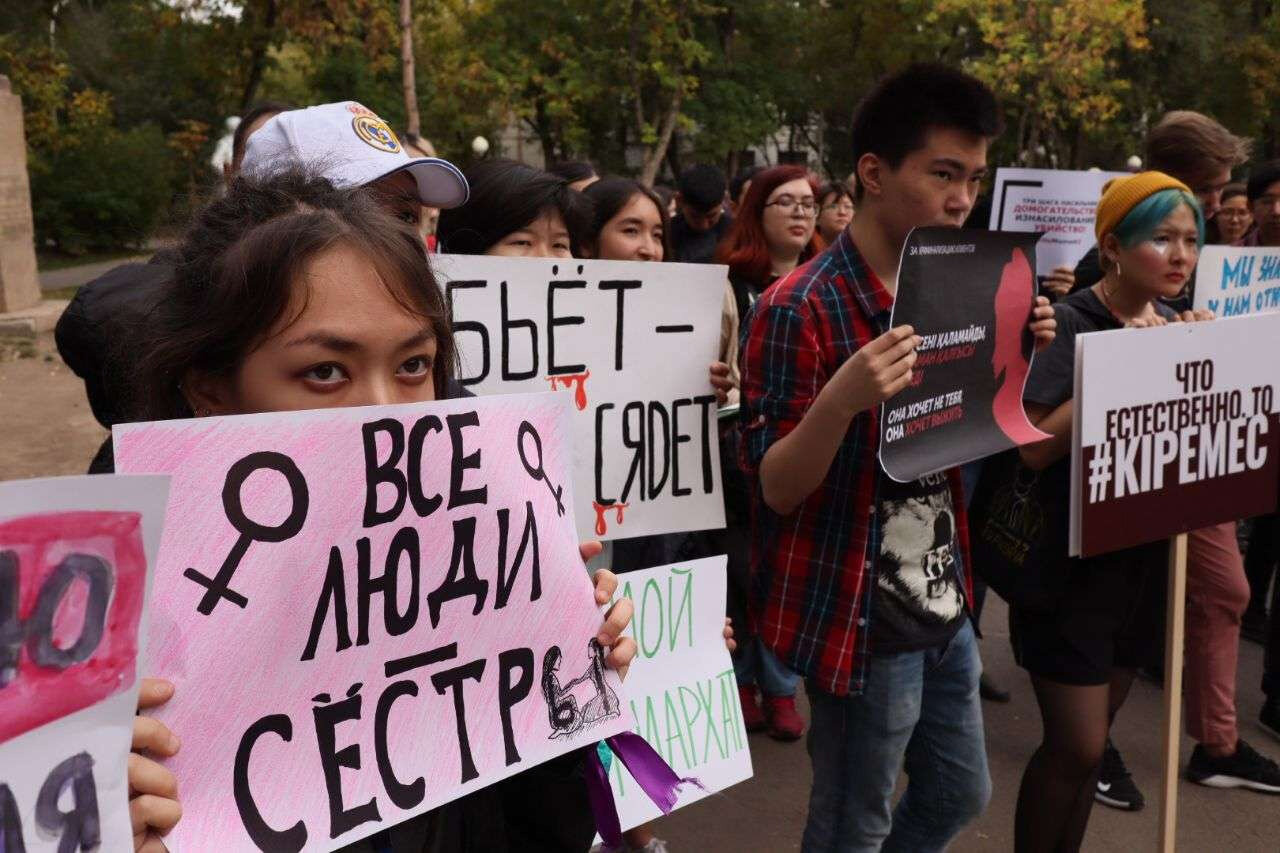
Peaceful protesters during the first sanctioned feminist demonstration in the history of the country on 28 September 2019 in Almaty, Kazakhstan. (Photo: Informburo.kz)
Reflections
Women have carried a significant weight of organizing and pushing pro-democratic change in the country for the past year, which fits the ubiquitous historical pattern of women being the faces and engines of change. From Asya Tulesova, a political and environmental activist who is unjustly prosecuted by the Kazakhstani government, to Assem Zhapisheva, Dinara Smailova, Zhanar Sekerbayeva, and many others, women in Kazakhstan are by no means passive subjects of the regime and the patriarchy.
Thus, while it seems that so many more people become victims of gender-based violence and the government is not in a hurry to protect them and challenge its patriarchal structure, Kazakhstani feminist activists continue the work of educating, raising awareness, and fighting for each other, and, therefore, attracting more and more attention to the issue of VAW. There is still a long way to go for Kazakhstan, Central Asia, and the rest of the world in eliminating gender-based violence, but the work of the grassroots feminist movement in the country cannot remain unacknowledged.
Aizada Arystanbek has a Masters in Gender and Women Studies from Central European University and is a young intersectionalist feminist academic and activist from Astana, Kazakhstan who believes in decolonization of academia and overthrowing patriarchy.
For further information, please contact: aarystanbek@gmail.com; www.linkedin.com/in/aizada-arystanbek/.
Endnotes
1 "The Shadow Pandemic: Violence against women during COVID-19," UNWomen, www.unwomen.org/en/news/in-focus/in-focus-gender-equality-in-covid-19-response/violence-against-women-during-covid-19.
2 Diana T. Kudaibergenova, "Project Kelin: Marriage, Women, and Re-Traditionalization in Post-Soviet Kazakhstan," in Mehrangiz Najafizadeh, Linda Lindsey (editors) Women of Asia: Globalization, Development, and Gender Equity, Routledge, 2019, pages 379-389.
3 Colleen Wood, "#MeTooTalgo: Kazakh Activists Push to Toughen Rape Law," The Diplomat, 29 August 2019, https://thediplomat.com/2019/08/metootalgo-kazakh-activists-push-to-toughen-rape-law/.
4 Heteronormative means "suggesting or believing that only heterosexual relationships are normal or right and that men and women have naturally different roles." Cambridge Dictionary, https://dictionary.cambridge.org/ja/dictionary/english/heteronormative.
5 Manshuq Asautay, "«Вернусь домой -- муж убьет». Бытовое насилие не снижается." ('If I go back home, my husband will kill me.' Violence against women does not decrease) Radio Azattyq, 29 November 2019, https://rus.azattyq.org/a/kazakhstan-domestic-violence-women/30298133.html.
6 Yuna Korostelyova and Maria Levina, "Бьет и будет бить: Как снизить количество жертв домашнего насилия и абьюзеров," (He hits you now and he will do it again: How to decrease a number of victims of domestic abuse and of abusers.) Vlast, 14 February 2020, https://vlast.kz/obsshestvo/37127-bet-i-budet-bit.html.
7 Reuters, "In Kazakhstan, 500 Detained After Protesting Election Seen as Shoo-In," The New York Times, 9 June 2019, www.nytimes.com/2019/06/09/world/asia/kazakhstan-election-president.html.
8 Heteronormativity is the idea that attraction and relationships between one man and one woman are the normal form of sexuality. Meg-John Barker, What's wrong with heteronormativity?, www.rewriting-the-rules.com/gender/whats-wrong-with-heteronormativity/.
9 See OHCHR | Kazakhstan Homepage," www.ohchr.org/EN/Countries/ENACARegion/Pages/KZIndex.aspx, accessed on 11 August 2020. See also
• Christina Wilkie, "Kazakhstan Is a 'kleptocracy' Ruled by an Autocrat. It's Also an Increasingly Important Strategic Ally," CNBC, 16 January 2018, www.cnbc.com/2018/01/16/kazakhstan-is-a-kleptocracy-ruled-by-an-autocrat-its-also-an-increasingly-important-strategic-ally.html.
• Hugh Williamson, "In Kazakhstan, Words but Little Action on Domestic Violence," Human Rights Watch, 3 December 2019, www.hrw.org/news/2019/12/03/kazakhstan-words-little-action-domestic-violence.
10 Short viral videos that can be found on Instagram.
11 Aery Duisenova, "In Kazakhstan, Women March for Their Rights - and against Violence," openDemocracy, 9 March 2020, www.opendemocracy.net/en/odr/kazakhstan-women-march-their-rights-and-against-violence/.
12 Daniyar Aysarov, "Первый Разрешённый Митинг Феминисток Прошёл в Казахстане." (First Legal Feminist Demonstration Occurred in Kazakhstan) Informburo, 28 September 2019, https://informburo.kz/novosti/pervyy-razreshyonnyy-miting-feministok-prohodit-v-kazahstane-.html.
Miriam Tabin
Enforced Disappearances
Overview Articles
Specific Articles
Environment and Human Rights
Overview Articles
Specific Articles
Kofi Otumawu-Apreku and Rosalie Masu
Pacific Islands Students Fighting Climate Change
Extra-Judicial Killing
Overview Articles
Specific Articles
Maria Socorro Diokno
Foreign residents
Overview Articles
Risk Communication and Community Engagement Working Group
Specific Articles
Solidarity Network with Migrants Japan
Julia Ioane, Teuila Percival, Winnie Laban, Ian Lambie
Miriam Tabin
Kinhide Mushakoji
HIV AIDS
Overview Articles
Specific Articles
Jose Narciso Melchor C. Sescon
HR and Development
Overview Articles
Satoru Matsumoto
Specific Articles
Andre Frankovits
Chisato Mano
Mieko Fujioka
Andre Frankovits
HR Concept
Overview Articles
Brigitte Dufour and Farid Tuhbatullin
Specific Articles
Nandini Mascarenhas
National Security Laws
Overview Articles
Specific Articles
NHRI
Specific Articles
Iranian Islamic Human Rights Commission
Rimyong Park
Non-governmental organizations
Specific Articles
Komai Tadayuki
Peace
Overview Articles
Specific Articles
Chisato Mano
Mieko Fujioka
Rene V. Sarmiento
Fatana Gailani
Refugees
Overview Articles
Jefferson R. Plantilla
Specific Articles
Keiko Tanaka
Australian Human Rights Commission test
Jagatmani Acharya
Right To Information
Overview Articles
Brigitte Dufour and Farid Tuhbatullin
Specific Articles
Social Media Exchange
Albert J. Rapha and Aufarizqi Imaduddin
Role of Government
Overview Articles
Brigitte Dufour and Farid Tuhbatullin
Specific Articles
Social Media Exchange
Zakia and Ishak Salim
Solidarity Network with Migrants Japan
Cecilia Jimenez-Damary, UN Special Rapporteur on the Human Rights of Internally Displaced Persons (2016-2022)
Ahmad Rizky M. Umar and Andika Putra
UNESCAP, Subregional Office for North and Central Asia
Miwako Hosoda
Praveen Kumar Yadav
International Federation for Human Rights and the Center for Prisoners' Rights Japan
Kenzo Tomonaga
Torture
Specific Articles
Trafficking
Overview Articles
Specific Articles
Vienna Conference
Specific Articles
PUBLICATIONS
-
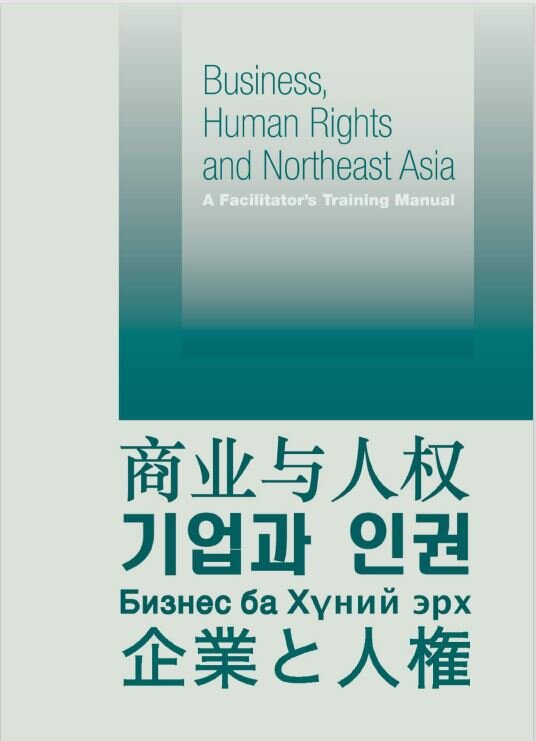 Business, Human Rights and Northeast Asia - A Facilitator's Training Manual
 -
 Bridging Human Rights Principles and Business Realities in Northeast Asia
 -
 Human Rights Education in the Northeast Asian School Systems - Resource Material
 -
 South Asian Teachers and Human Rights Education - A Training Resource Material
 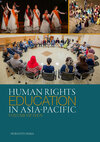 Human Rights Education in Asia-Pacific
-
 Law, Jurisprudence and Human Rights in Asia
 -
 Directory of Asia-Pacific Human Rights Centers
  FOCUS Asia-Pacific